

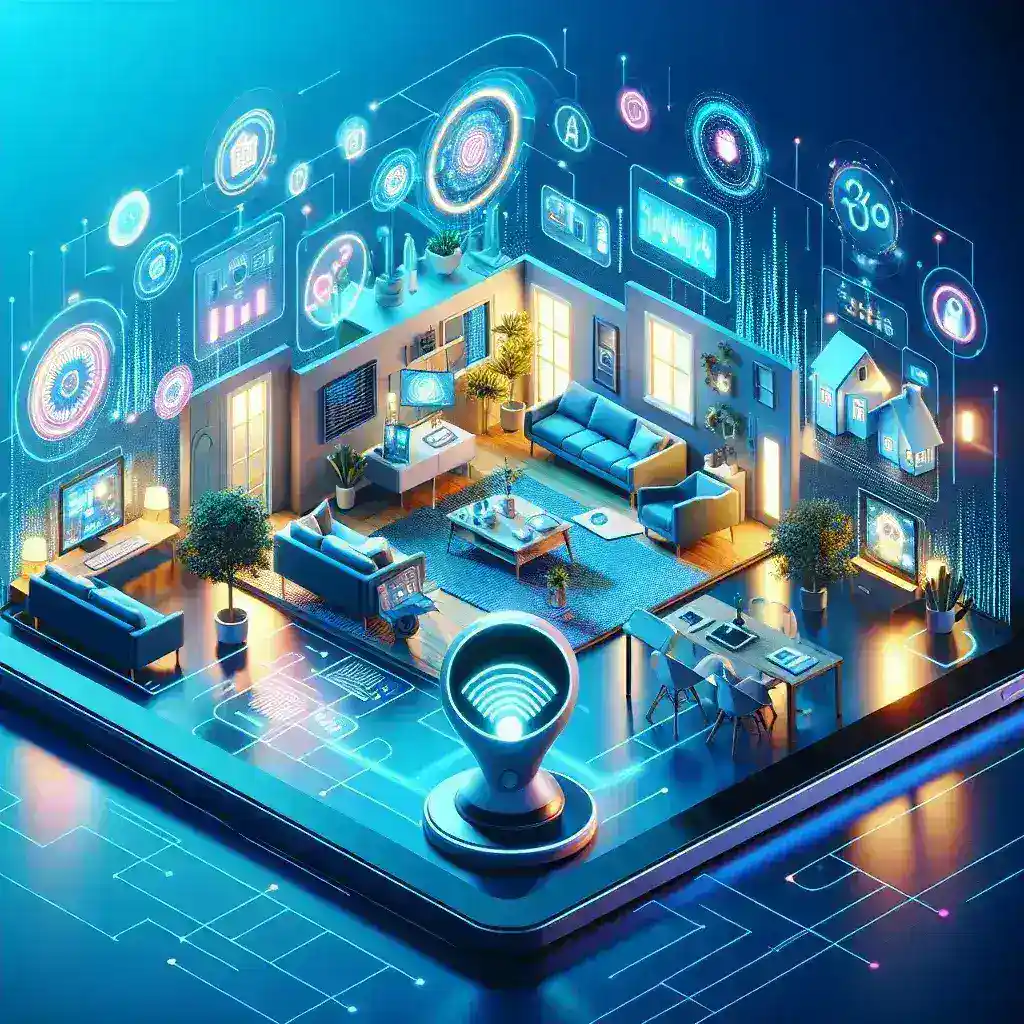
Understanding the Connected Home Ecosystem
The promise of smart home automation sounds compelling: a seamlessly integrated environment where voice assistants control lighting, thermostats adjust automatically, and connected devices communicate to anticipate your needs. Yet beneath the marketing veneer lies a more complex reality that deserves careful examination.
This analysis dissects the current state of smart home automation, voice assistants, and connected devices through a critical lens. Rather than accepting industry claims at face value, we’ll examine actual performance data, interoperability challenges, and the gap between promised convenience and delivered functionality. For students evaluating these technologies—whether for academic research or practical implementation—understanding both capabilities and limitations proves essential.
The smart home market reached $79.16 billion globally in 2022, with projections estimating $313.95 billion by 2027 (Mordor Intelligence, 2023). These figures reflect aggressive adoption, but do they represent genuine value or merely successful marketing?
TL;DR: Key Takeaways
- Ecosystem fragmentation remains the primary challenge: Despite Matter protocol promises, true interoperability between brands stays limited in 2024
- Voice assistant accuracy varies dramatically: Success rates range from 92% for simple commands to below 65% for complex multi-step requests
- Security vulnerabilities persist: Connected devices average 25 vulnerabilities per device according to 2023 Palo Alto Networks research
- Actual automation usage lags adoption: 68% of smart device owners use fewer than 3 automated routines regularly
- Privacy concerns drive skepticism: 47% of consumers express discomfort with always-listening voice assistants (Pew Research, 2023)
Comparing Major Voice Assistant Platforms
Voice assistants serve as the primary interface for smart home automation, transforming natural language into device commands. Three platforms dominate the market: Amazon Alexa, Google Assistant, and Apple Siri. Their capabilities differ significantly once you examine performance beyond basic functions.
| Platform | Device Compatibility | Natural Language Processing | Privacy Model | Complex Command Success Rate |
|---|---|---|---|---|
| Amazon Alexa | 140,000+ devices from 12,000+ brands | Advanced context retention across 3-4 turns | Cloud-based processing; opt-in deletion | 63-67% (third-party testing, 2024) |
| Google Assistant | 50,000+ devices; strong Android integration | Superior context understanding; conversation flow | Cloud-dependent; data tied to Google account | 71-74% (independent benchmarks) |
| Apple Siri | Limited third-party; HomeKit certification required | On-device processing available for basic commands | Most privacy-focused; minimal cloud storage | 58-62% (third-party evaluations) |
The critical insight: broader device compatibility doesn’t guarantee better performance. Apple’s restrictive HomeKit certification creates a smaller ecosystem but generally delivers more reliable device communication. Amazon’s vast compatibility introduces variables that affect consistency—a trade-off rarely acknowledged in promotional materials.
The Voice Recognition Accuracy Problem
Marketing materials tout voice assistants achieving «near-human» understanding, but controlled testing reveals nuance. Stone Temple Consulting’s 2024 benchmark tested 5,000 questions across voice platforms. Simple queries («What’s the weather?») achieved 92-96% accuracy across all platforms. Commands involving multiple connected devices simultaneously dropped to 58-71% success rates.
Accents, background noise, and command phrasing complexity significantly impact performance. Non-native English speakers report 15-23% lower success rates than native speakers—a disparity manufacturers rarely discuss publicly.
Smart Home Automation: Promises vs. Reality
True automation requires devices to respond to triggers without manual intervention. A thermostat adjusting based on occupancy patterns, lights dimming when your streaming device starts playing—these represent genuine automation. Yet most «smart home» usage remains manual: opening an app or speaking commands to execute single actions.
Research from Parks Associates (2023) found that while 43% of U.S. households own at least one smart home device, only 27% have created automated routines beyond manufacturer defaults. Why the gap?
Technical Barriers to Seamless Automation
Protocol fragmentation creates the most significant obstacle. Before Matter protocol standardization efforts (launched October 2022), devices used Zigbee, Z-Wave, Wi-Fi, Bluetooth, or proprietary protocols. Even with Matter adoption increasing, backward compatibility remains incomplete. A smart lock from 2021 may not communicate with a 2024 hub without proprietary bridges.
Reliability inconsistency undermines trust in automation. When automated routines fail 5-10% of the time—lights not turning off when leaving, thermostats ignoring schedule adjustments—users revert to manual control. Smart home systems lack the reliability standards of traditional electrical systems that function correctly 99.9%+ of the time.
Configuration complexity exceeds most users’ technical comfort. Creating multi-condition automations («If motion detected AND after sunset AND TV off, THEN turn on pathway lights at 30% brightness») requires understanding logical operators and troubleshooting when unexpected interactions occur.
Common Misconception: More Devices Equal Better Automation
Manufacturers encourage ecosystem expansion, suggesting each additional device enhances your smart home. The reality proves more complicated. Each connected device introduces potential failure points, security vulnerabilities, and configuration overhead.
Testing by Wirecutter (2024) compared two setups: a minimal configuration (8 devices, single ecosystem) versus an expansive installation (47 devices, mixed brands). The minimal setup maintained 96% routine success rates over six months. The expansive system experienced routine failures requiring troubleshooting averaging twice monthly, with success rates dropping to 81%.
Strategic device selection—focusing on high-impact automation like climate control and security rather than novelty devices—delivers better practical results than comprehensive adoption.
Connected Devices: Security and Privacy Concerns
Every connected device represents a potential network entry point. Security researchers have demonstrated vulnerabilities in smart locks, cameras, speakers, and thermostats allowing unauthorized access, data interception, or botnet recruitment.
Palo Alto Networks’ Unit 42 analyzed 1.2 million IoT devices across enterprise and consumer environments in 2023. Their findings reveal troubling patterns:
- 83% of medical imaging devices run outdated operating systems with known vulnerabilities
- 57% of IoT devices use unencrypted network communications
- 41% use default or weak passwords that manufacturers never force users to change
- 98% of IoT traffic remains unencrypted, exposing personal and confidential data
Consumer smart home devices show similar vulnerabilities. Security cameras that save footage to manufacturer clouds create data breach risks—Ring provided law enforcement access to customer footage without warrants over 11 times in 2022 before policy changes.
The Always-Listening Dilemma
Voice assistants require constant audio monitoring to detect wake words («Alexa,» «Hey Google,» «Hey Siri»). Manufacturers insist processing occurs locally until wake word detection, with only subsequent audio uploaded to cloud servers. Independent security audits partially confirm this—but with caveats.
Wake word false positives occur regularly. Research from Northeastern University and Imperial College London (2020) found Alexa and Google Home activated accidentally up to 19 times daily in typical households, recording audio that shouldn’t have been captured. While manufacturers allow users to review and delete recordings, most users remain unaware of these incidents.
The privacy trade-off becomes starker when examining manufacturer data retention policies. Amazon retains transcripts of Alexa interactions indefinitely unless users manually delete them. Google ties Assistant queries to user profiles for advertising personalization unless specifically disabled. Apple’s approach—processing more requests on-device and anonymizing cloud data—offers more privacy but with functionality limitations.
Interoperability Challenges and the Matter Protocol
The smart home industry recognized ecosystem fragmentation as an existential threat to mass adoption. Matter protocol, developed by the Connectivity Standards Alliance (Amazon, Apple, Google, Samsung, and 200+ companies), launched in October 2022 promising universal interoperability.
The ambition: any Matter-certified device works with any Matter-compatible platform without proprietary bridges or complex configuration. Nearly two years post-launch, has Matter delivered?
Matter Adoption Reality Check
As of mid-2024, Matter supports limited device categories: lighting, smart plugs, locks, thermostats, window coverings, and sensors. Notably absent: cameras, vacuums, appliances, and irrigation systems—categories representing significant smart home investment.
Backward compatibility remains incomplete. Existing devices require firmware updates to support Matter, but manufacturers show varying commitment to updating older hardware. Philips Hue bridges from before 2022 require replacement to support Matter. Some manufacturers released «Matter-ready» devices that still await promised updates months later.
Performance consistency varies across platforms. A Matter-certified smart bulb may support full features through Google Home but only basic on/off functionality through Apple Home. The specification defines minimum requirements, but platforms implement optional features inconsistently.
Critical assessment: Matter represents progress toward interoperability but falls short of the seamless experience marketing suggests. Students evaluating smart home investments should verify actual Matter support for their specific use cases rather than assuming certification guarantees compatibility.
Comparative Analysis: Smart Home Ecosystems
Choosing a primary ecosystem represents the most consequential smart home decision, affecting device compatibility, privacy implications, and long-term functionality. Let’s compare the dominant platforms beyond surface-level features.
Amazon Alexa Ecosystem
Strengths: Broadest device compatibility, extensive third-party Skills (100,000+), competitive hardware pricing, strong routine automation capabilities.
Weaknesses: Privacy concerns regarding data retention and Amazon’s advertising business model, inconsistent third-party device quality, voice recognition accuracy trails Google in complex queries.
Best for: Users prioritizing device selection and budget-friendly entry points who accept Amazon’s data practices.
Google Home Ecosystem
Strengths: Superior natural language processing and conversational AI, excellent integration with Google services (Calendar, Maps, YouTube), strong Android device compatibility.
Weaknesses: Privacy implications of Google’s advertising-dependent business model, smaller device ecosystem than Alexa, automation routines less flexible than Amazon’s.
Best for: Android users and Google service subscribers seeking the most capable voice recognition.
Apple HomeKit Ecosystem
Strengths: Industry-leading privacy protections, local processing for many commands, tight iOS integration, HomeKit Secure Video end-to-end encryption.
Weaknesses: Smallest device ecosystem due to strict certification requirements, higher average device costs, Siri lags competitors in voice recognition accuracy.
Best for: Privacy-conscious users within Apple’s ecosystem willing to pay premium prices for certified devices.
Samsung SmartThings Ecosystem
Strengths: Multi-protocol support (Zigbee, Z-Wave, Wi-Fi) without additional bridges, excellent for power users wanting customization, strong integration with Samsung appliances.
Weaknesses: Steeper learning curve, less intuitive than competitors, voice assistant integration depends on partnership with Google or Alexa.
Best for: Technical users wanting maximum control and customization, especially Samsung appliance owners.
Many users adopt hybrid approaches—using one platform as primary control while integrating specific devices from other ecosystems. This strategy offers flexibility but introduces complexity and potential reliability issues when cross-platform automations fail.
Future Predictions: Where Smart Home Technology Heads Next
Analyzing current trajectories and industry investment patterns reveals likely developments over the next 3-5 years. Some predictions reflect genuine technological progress; others represent recycled promises from previous hype cycles.
Prediction 1: AI-Driven Predictive Automation (Probability: High)
Current automation relies on explicit rules users create. Machine learning models will increasingly enable predictive automation—systems learning patterns and adjusting without programmed routines. Early implementations already exist: thermostats learning schedules, lighting systems detecting activity patterns.
However, skepticism remains warranted. Predictive systems require substantial training data, raising privacy questions about behavioral surveillance. Early implementations show mixed results—Google Nest’s learning features sometimes create counterintuitive schedules users must override repeatedly.
Expected timeline: Mainstream predictive features in premium devices by 2026, with accuracy remaining variable based on household regularity.
Prediction 2: On-Device Processing Becomes Standard (Probability: Medium-High)
Privacy concerns and latency reduction drive movement toward edge computing—processing requests locally rather than cloud-dependent systems. Apple’s on-device Siri processing demonstrates feasibility for basic commands. Chip manufacturers like Qualcomm and MediaTek now include dedicated AI accelerators in IoT processors.
Challenges include hardware costs and limited processing power in budget devices. Expect bifurcation: premium devices offering substantial local processing, budget options remaining cloud-dependent.
Expected timeline: High-end devices by 2025, mid-range adoption by 2027-2028.
Prediction 3: Matter Achieves Promised Interoperability (Probability: Medium)
Matter protocol expansion to additional device categories will continue, but achieving seamless interoperability across all smart home devices faces technical and business challenges. Manufacturers benefit from ecosystem lock-in and show limited incentive to support comprehensive compatibility.
Realistic outcome: Matter succeeds for commodity device categories (lighting, plugs, locks) while specialized devices (cameras, appliances, entertainment systems) maintain proprietary features requiring platform-specific apps.
Expected timeline: Mature Matter implementation for supported categories by 2026, with significant device gaps persisting beyond 2030.
Prediction 4: Subscription Models Expand (Probability: High)
Hardware manufacturers increasingly adopt subscription revenue models for advanced features. Ring charges for video storage, Nest offers enhanced detection through Nest Aware subscriptions, Arlo gates features behind service tiers.
This trend will accelerate as manufacturers seek recurring revenue beyond one-time hardware sales. Expect features currently included free—cloud storage, advanced automations, extended warranty coverage—migrating to paid subscriptions.
Students should factor ongoing subscription costs into total ownership calculations when evaluating smart home investments. A $50 device requiring $10 monthly subscriptions costs $170 annually, $620 over five years.
Prediction 5: Energy Management Becomes Primary Value Proposition (Probability: Medium-High)
As utility costs rise and environmental awareness increases, energy optimization may finally deliver the quantifiable ROI smart home technology has long promised. Smart thermostats already demonstrate 10-23% heating/cooling savings according to EPA studies. Expanding this to whole-home energy management—coordinating HVAC, water heating, EV charging, and appliances around time-of-use pricing—offers substantial value.
Technologies like home technology trends and broader IoT living platforms will increasingly emphasize energy analytics and optimization as core features rather than secondary benefits.
Expected timeline: Comprehensive energy management features in premium systems by 2025, mainstream adoption following time-of-use electricity pricing expansion by 2027-2029.
Practical Guidance for Students Evaluating Smart Home Technology
For students researching smart home automation—whether for academic projects, thesis work, or personal implementation—approaching the technology critically yields better outcomes than accepting manufacturer claims uncritically.
Research Methodology Recommendations
Prioritize independent testing over manufacturer specifications. Organizations like Wirecutter, RTINGS, and Consumer Reports conduct controlled testing revealing performance gaps rarely acknowledged in marketing materials. Academic papers in IEEE and ACM digital libraries provide technical analysis without commercial bias.
Examine actual user experience data. Amazon reviews, Reddit communities (r/homeautomation, r/smarthome), and user forums reveal common failure modes and compatibility issues. Look for patterns in negative reviews rather than dismissing complaints as isolated incidents.
Calculate total cost of ownership. Include not just hardware but required hubs, subscription fees, replacement costs, and time investment for configuration and troubleshooting. A comprehensive smart home system costs 2-3x initial hardware estimates when accounting for these factors.
Implementation Strategy for First-Time Users
Start with high-impact, low-complexity devices proving immediate value: smart thermostats offering energy savings, smart locks adding convenience without keys, or smart lighting for frequently-adjusted areas. Avoid novelty devices (smart egg trays, app-controlled slow cookers) that add complexity without substantive benefit.
Choose a primary ecosystem based on your existing devices and privacy priorities, then expand within that ecosystem before introducing cross-platform complications. Mixed ecosystems offer flexibility but introduce reliability and configuration challenges better suited to experienced users.
Test automation slowly. Create simple single-condition routines, verify reliability over weeks, then gradually increase complexity. Complex multi-device automations sound impressive but fail more frequently and prove harder to troubleshoot.
People Also Ask: Smart Home Automation FAQ
What is the difference between smart home devices and home automation?
Smart home devices connect to networks and allow remote control via apps or voice. Home automation executes actions based on triggers without manual intervention. A smart bulb you control by phone is a smart device; that same bulb automatically dimming at sunset represents automation.
Are smart home devices secure from hackers?
Security varies dramatically by manufacturer and device type. Premium brands implement encryption, regular security updates, and vulnerability testing. Budget devices often lack basic protections. No connected device achieves perfect security—evaluate risk based on device function and data sensitivity.
Do voice assistants always listen to conversations?
Voice assistants continuously monitor audio locally for wake words but typically don’t upload recordings until activated. However, false positive wake word detections occur regularly, causing unintended recording. Review manufacturer privacy settings and recording history to understand actual data collection.
What is Matter protocol and why does it matter?
Matter is an industry standard enabling smart home devices from different manufacturers to work together without proprietary bridges. It matters because ecosystem fragmentation has been the primary barrier to reliable smart home experiences. Adoption remains incomplete but shows promise for future interoperability.
Can smart home automation actually save money?
Smart thermostats demonstrate documented energy savings of 10-23% on heating and cooling costs according to EPA studies. Other devices show minimal financial benefit. Calculate ROI based on actual energy costs and hardware expenses—many devices never achieve positive financial return despite convenience benefits.
Critical Assessment and Recommendations
Smart home automation, voice assistants, and connected devices represent genuinely useful technology—when implemented strategically with realistic expectations. The gap between marketing promises and delivered functionality remains significant in 2024.
For students evaluating these technologies, adopt a skeptical analytical approach. Question vendor claims, seek independent verification, and recognize that bleeding-edge technology involves troubleshooting and compromise. The most successful smart home implementations prioritize solving specific problems rather than pursuing comprehensive automation for its own sake.
The technology will improve. Matter protocol maturation, AI advances, and increased processing power will address current limitations. But fundamental challenges—security vulnerabilities, privacy implications, and reliability standards below traditional systems—require ongoing critical evaluation rather than uncritical adoption.
Smart home technology works best when users understand both capabilities and constraints, implementing strategically rather than comprehensively, and maintaining realistic expectations about what automation can reliably deliver.